
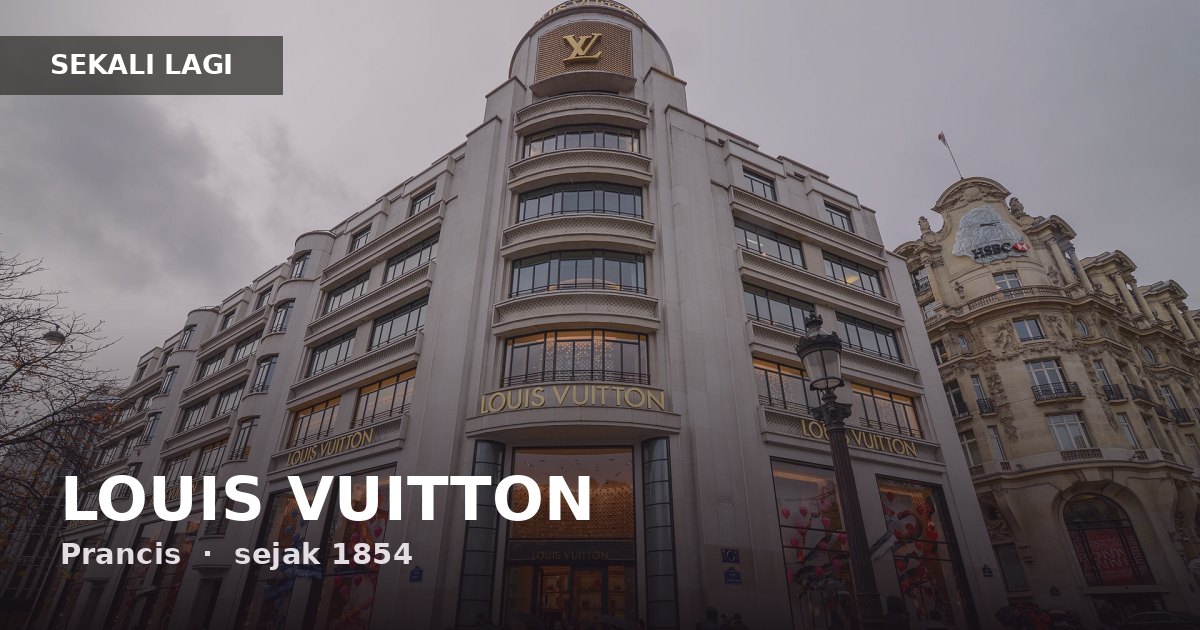
Louis Vuitton is a French fashion house founded by Louis Vuitton in 1854 on Rue Neuve des Capucines, Paris. The brand was first known for trunks. Its first breakthrough came in 1858: a flat-topped trunk made of Trianon canvas that was light and easy to stack when traveling. Since 1896 the house has used Monogram Canvas, a pattern with the LV letters, quatrefoil, and flowers, which is still the brand's best-known mark today. From trunks, the line grew to include bags, wallets, shoes, watches, and clothing. For buyers of secondhand bags, there are many models from different eras to choose from, and some of them, such as the Speedy and Noé, are still made today.
Read more
Louis Vuitton started his brand in 1854 in Paris. He noticed that the Osilite trunks made by H. J. Cave were easy to stack. In 1858 he introduced a flat-topped trunk made of gray Trianon canvas. Trunks of that time generally had rounded tops so that water would run off, which meant they could not be stacked. His design was widely copied. Because of this, he changed the canvas to cream and brown stripes in 1876, then created the Damier pattern in 1888, complete with the words "marque L. Vuitton déposée". He died in 1892 and the company was taken over by his son, Georges.
Georges took the brand onto the world stage. He showed its products at the Chicago World's Fair in 1893 and visited several cities in the United States. In 1896 the Monogram Canvas was launched and patented in various countries. Its symbols, including the quatrefoil and flowers, followed the late Victorian-era trend for mon, Japanese family crests. The patent is said to have stopped counterfeiting, but counterfeiting became widespread again from around the 1920s. Models that are often sought after today were born in this period: the Steamer Bag (1901), Keepall (1930), Noé (1932), and then the Speedy.
After 1945, leather was used in most products. In 1959 the Monogram Canvas was made more flexible so that it suited bags and wallets. The Papillon followed in 1966. The leather lines grew: Epi (1985), Taiga (1993), Utah and Suhali (2003). Marc Jacobs became artistic director in 1997 and designed the brand's first ready-to-wear clothing in 1998. His era saw limited-edition collaborations, among them Stephen Sprouse's graffiti (2001) and Takashi Murakami's Monogram Multicolore (2003). Damier Graphite arrived in 2008.
- Keepall: a travel bag introduced in 1930.
- Noé: introduced in 1932, originally made so that champagne sellers could carry bottles, and still in production.
- Speedy: appeared shortly after the Noé and is also still in production today.
- Papillon: a cylindrical bag launched in 1966.
- Steamer Bag: a small bag from 1901 designed to be stored inside Vuitton trunks.
Louis Vuitton is currently empty. Preloved pieces arrive one at a time, check again after the next drop.
What we check before listing
We start with the pattern: the monogram or Damier should be neat, symmetrical, and not cut off oddly at seams, pockets, and edges. We check the stitching for tightness and evenness, especially on the handles and corners. We look at the hardware for engraving, color, and how the zipper or lock works. The writing, stamps, and labels on the inside are checked for typeface, spacing, and position. The condition of the leather edges, corners, and lining is also noted, because these parts wear out fastest. All of this is our usual way of checking, not a guarantee of authenticity.
Caring for it
Store the bag in a dry, cool place, away from rain and damp, and stuff it with paper to keep its shape. Clean the canvas with a soft, slightly damp cloth, and do not rub hard. Keep leather away from direct sunlight and from rubbing against dark-colored clothing. Use a dust bag when storing it, and take it to a professional bag care specialist if there is a stubborn stain.
FAQ
What is the difference between Monogram and Damier?
Damier is older, created in 1888 with the words "marque L. Vuitton déposée". Monogram Canvas was launched in 1896 with the LV letters, quatrefoil, and flowers. Both were made to make copying harder.
Are Louis Vuitton bags often counterfeited?
Yes, counterfeiting is said to have become widespread from around the 1920s and continues to this day. That is why we check the pattern, stitching, hardware, and labels thoroughly. Even so, our checks are not an absolute guarantee.
Which models are still in production?
According to our sources, the Noé and Speedy are still made. Both date from the early 1930s, so many old and new versions circulate on the secondhand market.
What about collaboration editions such as Murakami or Sprouse?
Both are limited editions. The Stephen Sprouse graffiti appeared in 2001. Takashi Murakami's Cherry Blossom pattern was used on only a few products and its production was stopped in June 2003. Because they are rare, we check them more carefully.
References
Facts summarised and rewritten from the sources above (CC BY-SA licence).