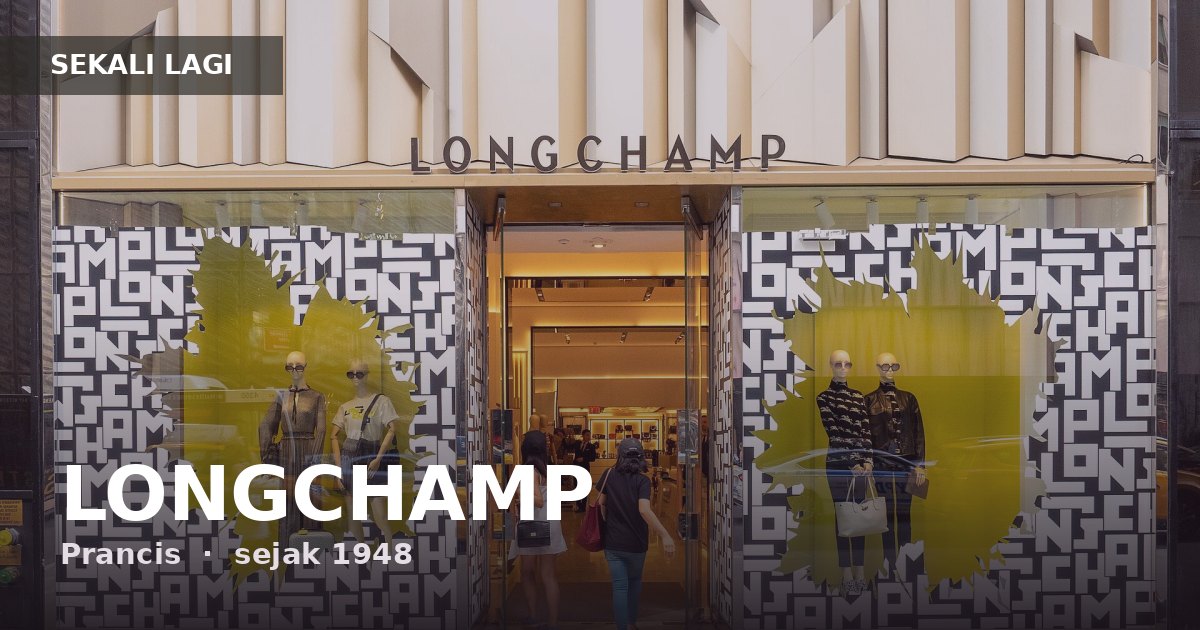
Longchamp is a French leather goods house founded in Paris in 1948. Its founder, Jean Cassegrain, took over his father's tobacco shop, then became known for leather-covered smoking pipes. From there the business grew to wallets, passport covers, and bags. Its first women's handbag came out in 1971. To this day Longchamp is associated with lightweight nylon bags with leather handles, especially Le Pliage, designed in 1993. Its logo is a jockey on a galloping horse, referring to the name of the Longchamp racecourse in Paris. The company is still owned and run by the Cassegrain family. For buyers of secondhand bags, Longchamp is appealing because its models are practical for everyday use and its design history is easy to trace.
Read more
In 1948 Jean Cassegrain took over his father's tobacco shop, "Au Sultan," in Paris. After World War II, Allied soldiers became customers, and pipes became the most profitable item. In the 1950s he introduced pipes covered in exotic leather. The Cassegrain family name was already being used by distant relatives for a paper business, so he chose the name of the Longchamp racecourse. The name also alludes to a flour mill near the racecourse, since Cassegrain means grain grinder in French. From there came the logo of a jockey on a horse.
The success of the pipes led him to make wallets, passport covers, and bags for men. The first workshop opened in Segré in 1959. In the 1970s Longchamp is said to have been the first company to make bags from nylon, through a collection of nylon and leather luggage that was much lighter than ordinary luggage at the time. Its first women's handbag was born in 1971 from a toiletry bag that was given a shoulder strap and two flaps. In 1978 the LM line of printed leather arrived, and items for smokers were no longer in the catalog.
In 1993 Philippe Cassegrain, the founder's son, designed Le Pliage. The bag combines a nylon body with leather handles and can be folded into a trapezoid shape like an envelope. According to our sources, in 2018 Longchamp's six factories in France produced half of the bags sold, and the rest were made by partners. Since 2005 Jeremy Scott has regularly designed special editions of Le Pliage, and the brand also works with other artists and designers. In 2020 Longchamp launched Green District, its first line made from recycled Econyl nylon fiber.
- Le Pliage: a nylon tote with leather handles that can be folded into a trapezoid shape, designed by Philippe Cassegrain in 1993.
- LM: Longchamp's first women's bag line made of printed leather, introduced in 1978 and re-released in 2008.
- Zip Bag: a bag designed by Thomas Heatherwick from the 2004 collaboration, made up of one long zipper.
- Xtra-Bag: a bag that can be folded down to a quarter of its size and is considered the predecessor of Le Pliage.
- Green District: a bag line made from recycled Econyl nylon, launched in August 2020.
Longchamp is currently empty. Preloved pieces arrive one at a time, check again after the next drop.
What we check before listing
For Le Pliage, we first look at the folds and the bottom corners of the bag, because the nylon there is the most likely to wear, thin out, or have its coating peel. We check the leather handles and trim for cracks, dry lines, stains, and peeling edges. The zipper must slide smoothly without sticking, and so must any snaps or fasteners. We look closely at the stitching around the handles, where the load is greatest, as well as the labels and the jockey-on-horse logo on the bag. Because there are many models and some are collaboration editions, we compare the shape, color, and details with the model in question. All of this is our own observation, not a guarantee of authenticity.
Caring for it
The nylon parts can be cleaned with a damp cloth and mild soap, then dried in the shade. Avoid drying the bag in direct sunlight, because the color can fade and the leather can dry out. For leather handles or trim, wipe with a clean cloth and apply a little leather moisturizer if needed. When storing, fold Le Pliage neatly and do not put heavy objects on top of it so the folds do not wear out quickly.
FAQ
What does the name Le Pliage mean?
Le Pliage means 'the fold' in French. The bag was designed by Philippe Cassegrain in 1993 and can be folded into a trapezoid shape like an envelope.
Why is the Longchamp logo a jockey on a horse?
Jean Cassegrain used the name of the Longchamp racecourse in Paris as the brand name, so a jockey on a galloping horse was chosen as the logo.
Are all Longchamp bags made in France?
Not all of them. According to our sources, in 2018 half of the bags were made in Longchamp's six factories in France, and the other half by partners. For any particular bag, the label and product details need to be looked at in person.
Are there special edition Le Pliage bags to watch out for?
Yes. Since 2005 Jeremy Scott has designed special editions of Le Pliage almost every year, and there are also collaborations with Tracey Emin, Mary Katrantzou, Sarah Morris, and Pokémon. Editions like these have their own patterns, so it is best to compare them with the model in question.
References
Facts summarised and rewritten from the sources above (CC BY-SA licence).