
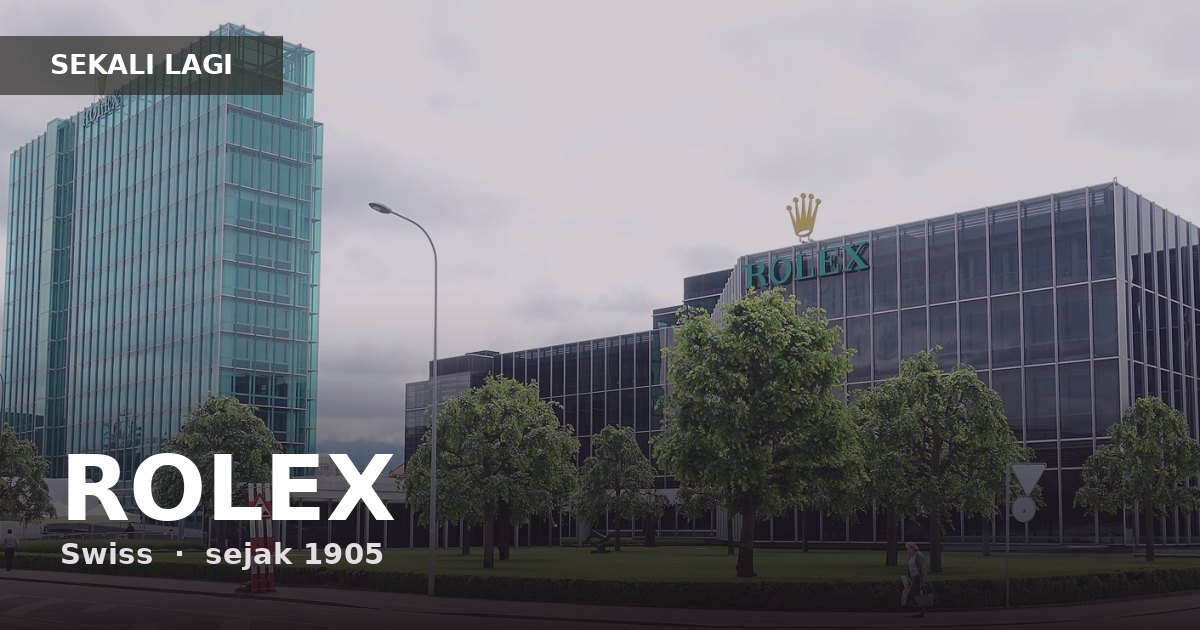
Rolex is a Swiss luxury watchmaker now based in Geneva. The company began in London in 1905 as Wilsdorf and Davis, founded by Hans Wilsdorf and Alfred Davis. The Rolex name was registered in 1908, and around the late 1910s its base moved to Switzerland. Rolex is best known for the Oyster, a watch with a tightly sealed case introduced in 1926, and for the Perpetual rotor in 1931, which let a watch wind its own mainspring conveniently. Since 1960 the company has been owned by the Hans Wilsdorf Foundation. For secondhand buyers, Rolex has its own advantage: serial numbers, materials, and bezel styles changed over time, so the era of a watch can be read from its features.
Read more
Wilsdorf and Davis did not start out as a full watchmaker. In 1905 in London, Hans Wilsdorf and Alfred Davis imported Swiss watch movements, mainly made by Hermann Aegler, and fitted them into cases made by other companies. Those early watches were sold to various jewelry shops, which put their own names on the dial. The earliest W&D watches are usually marked "W&D" on the inside of the caseback. In 1908 Wilsdorf registered the Rolex brand. He wanted a name that was easy to pronounce in any language and short enough to fit on a watch face. The company became Rolex Watch Co. Ltd. in 1915, then moved to Geneva because of import taxes on luxury goods and high export duties on silver and gold after the war.\nThe next technical problem it pursued was dust and moisture getting in through the dial and the crown. The answer was the Oyster in 1926, a watch with a tightly sealed case. Rolex bought a patent that allowed the watch to be set without giving up protection from water, then marketed it heavily. In 1927 the British swimmer Mercedes Gleitze swam the English Channel with an Oyster around her neck, and Rolex ran an advertisement about it in the Daily Mail. In 1931 Rolex patented the Perpetual rotor, a semicircular weight that moves freely under gravity. From then on the Oyster became known as the Oyster Perpetual.\nWilsdorf established the Hans Wilsdorf Foundation in 1944 and placed all his shares in it. Since his death in 1960, the foundation has owned Rolex. In 1946 Tudor was born, a sister brand with similar reliability at a lower price. In terms of materials, Rolex has used 904L steel since 1985 and the Cerachrom ceramic bezel since 2005, first on the GMT-Master II. In 2004 Rolex acquired Aegler, its longtime movement supplier, to increase its production of its own components.
- Oyster Perpetual: a direct descendant of the 1926 Oyster, with the Perpetual rotor patented in 1931.
- GMT-Master II: the first model to use the Cerachrom ceramic bezel, in 2005.
- Submariner: one of Rolex's professional watches, which now uses a ceramic bezel.
- Milgauss: known for its magnetic shield, which was later also used on the 2016 version of the 40 mm Air-King.
- Air-King: began with the 1958 Air-Prince line to honor RAF pilots, was discontinued in 2014 and returned in 2016.
What we check before listing
We match the serial number to the style of the watch, because the serial number format changed: sequential from 1926, with a letter added in 1987, and random since 2010. The bezel is examined carefully. Older aluminum bezels can fade from UV light, while ceramic bezels usually keep their color sharp but still need to be checked for cracks or chips. Because 904L steel is softer and scratches easily, we look at whether the case and lugs have been over-polished until the edges are rounded. We also check whether the crown, caseback, and bracelet (Oyster, Jubilee, or President) match and are not too loose. Service history and complete documents help, but we read all of it as clues, not as a guarantee of authenticity.
Caring for it
904L steel resists corrosion but scratches more easily, so avoid knocks against hard surfaces and use a soft cloth to clean it. Ceramic bezels resist scratches and their color does not fade, but they can crack if hit hard. Water resistance depends on the condition of the crown and seals, so an older watch should be checked before it is worn swimming. Regular servicing at an authorized service center or a trusted watch workshop keeps the movement healthy.
FAQ
How can I find out the production year of a Rolex?
The serial number can indicate an approximate production period. Serial numbers started in 1926 and ran sequentially until 1954, then started again from the beginning. In 1987 a letter was added, and since 2010 the numbers have been random, so the latter cannot be used to guess the year.
What is the difference between Rolex and Tudor?
Tudor is a sister brand created by Hans Wilsdorf in 1946. The aim was to offer Rolex-like reliability at a lower price. Tudor initially used ETA movements, and since 2015 it has begun using in-house movements.
Do all Rolex watches have ceramic bezels?
No. The Cerachrom ceramic bezel has only been used since 2005, first on the GMT-Master II. Older models use aluminum bezels whose color can fade, so the condition of the bezel is also a clue to age.
Are all Rolex watches mechanical?
Most are, including self-winding watches with the Perpetual rotor. Rolex also made a few quartz models in the Oyster line, such as the Oysterquartz, whose movement was developed in the late 1960s to the early 1970s.
References
Facts summarised and rewritten from the sources above (CC BY-SA licence).