
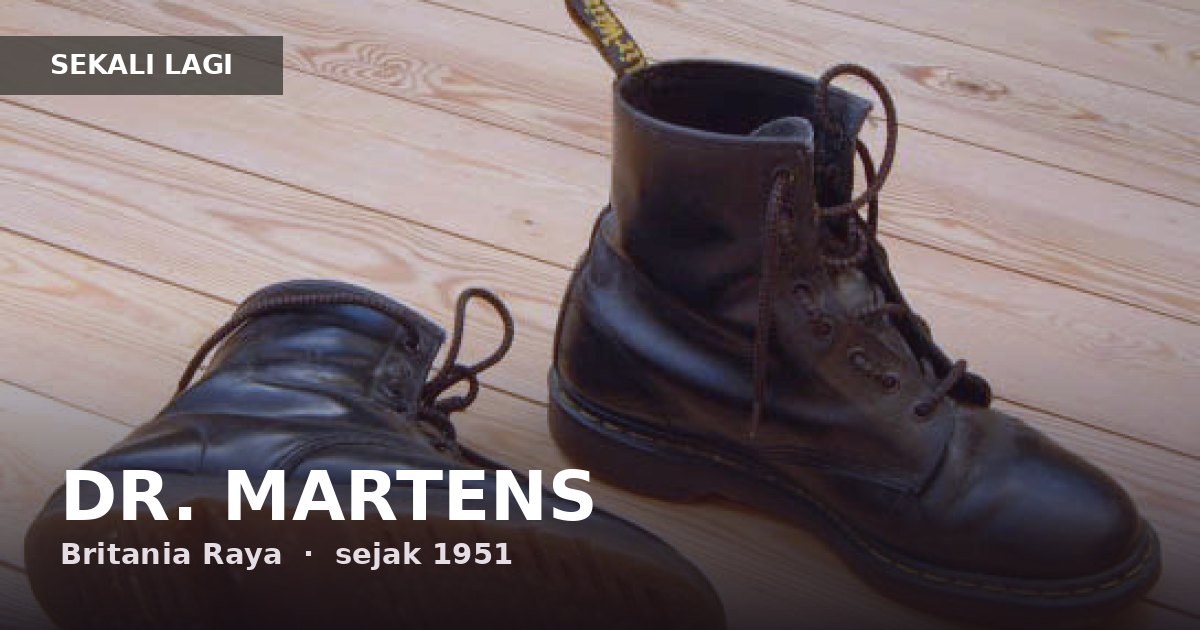
Dr. Martens, often called Doc Martens, Docs, or DM, is a footwear brand from the United Kingdom. The original design came from Klaus Märtens, a doctor in the German Army, who made boots with air-cushioned soles after injuring his ankle. The English version came about through the R. Griggs Group, with yellow stitching and a sole registered as a trademark. Its easily recognized features are the air-cushioned sole, the distinctive shape of the upper, welted construction, and yellow stitching. The shoes were first worn by postal workers, police officers, and factory workers, then adopted by skinheads, punks, and grunge fans. To this day the 1460 and 1461 models remain the best sellers.
Read more
The story begins in Germany. In 1945 Klaus Märtens injured his ankle while skiing, and he designed an improvement for his boots. After the war ended, he bought leather from a shoemaker's shop and made a pair of boots himself with an air-cushioned sole. In 1947 he met his university friend Herbert Funck in Munich. The two opened a business in Seeshaupt, using discarded rubber that was molded into soles. In the first decade, 80 percent of sales actually came from women over the age of 40. The Munich factory opened in 1952.
In 1959 Märtens and Funck began thinking about the international market. The British shoe manufacturer R. Griggs Group soon bought the patent rights to produce the boots in the United Kingdom. The company name was changed to Dr. Martens, the heel was reshaped for a better fit, yellow stitching was added, and the sole was registered as a trademark. The eight-eyelet boot in smooth cherry red leather launched on 1 April 1960 as style 1460. The three-eyelet shoe, numbered 1461, followed a year later. Production was centered at the Cobbs Lane factory in Wollaston, Northamptonshire, and several other factories made it under license.
In 2003 production in England was stopped and moved to China and Thailand. Since 2004 the Wollaston factory has been making the Vintage line again, to the original specifications. Today Dr. Martens is produced in England, China, Vietnam, Laos, and Thailand. Because of this, a pair of secondhand DMs can come from different locations and production periods.
- 1460: An eight-eyelet boot introduced on 1 April 1960, with the original version in smooth cherry red leather.
- 1461: A three-eyelet shoe released exactly one year after the 1460, and also a sales staple.
- Vintage: A line made at the Wollaston factory since 2004 to the original specifications.
- Vegan line: Boots made from synthetic polyurethane, introduced in 2011.
What we check before listing
We look at the condition of the air-cushioned sole: the middle and the edges should not be cracked, peeling, or worn too flat. The yellow stitching and the welt stitching are checked to make sure nothing is broken or loose. We look closely at the label and the country-of-origin stamp, because DMs are made in several countries and condition can differ between production periods. The leather is checked at the creases around the toes and ankle for cracking, peeling, or excessive dryness. We also check the eyelets, the hooks, and the pull tab at the heel.
Caring for it
Wipe off dust and mud with a damp cloth, then let the boots dry in a shaded place, away from direct sunlight and heaters. For leather, use a conditioner or shoe wax regularly so it does not dry out and crack. Stuff the boots with paper or use a shoe tree when storing them to keep their shape. For vegan models, simply wipe them clean and avoid oil-based moisturizers, which are not suitable for synthetic materials.
FAQ
What is the difference between the 1460 and the 1461?
Both were introduced in England and became the best-selling models. The 1460 is an eight-eyelet boot from 1 April 1960, while the 1461 is a three-eyelet shoe released a year later.
Are all Dr. Martens made in England?
No. Today DMs are made in England, China, Vietnam, Laos, and Thailand. Production at the Wollaston factory in Northamptonshire is now mainly for the Vintage line. Check the label inside the shoe to find out the country of manufacture.
Do older DMs last longer than newer ones?
In 2019 The Guardian reported complaints from readers that newer products were less durable. The company stated that there was no change in materials or processes after production moved to Asia. For that reason we judge each pair by its actual condition, not by its year or country of production alone.
Are secondhand DM boots comfortable to wear?
Comfort depends heavily on how they were worn before. Classic leather boots usually need time to adjust to the shape of your foot, and a secondhand sole that has worn thin or cracked will feel different. Choose a size that fits and look carefully at the photos of the sole.
References
Facts summarised and rewritten from the sources above (CC BY-SA licence).